
LEDs (Light Emitting Diodes) are now a widespread and well-known light source in our ordinary life, very reliable, and with very low energy consumption. But more than 15 years ago, BioSystems pioneered its use in the clinical and food analysis laboratories.
Brief history of the discovery of LEDs
In 1907, Henry Joseph Round of Marconi Labs observed electroluminescence in silicon carbide crystals, which can be considered as the first indication of the LED phenomenon. Between 1920 and 1950, several researchers studied electroluminescence in semiconductors, but without making practical applications of it.
In 1961, Gary Pittman and James Robert Biard of Texas Instruments created the first practical infrared LED (890–900 nm).
Between 1962 and 1970, red-orange and yellowLEDs were developed. In 1972, George Craford of Bell Labs, a former graduate student of Holonyak, developed the first high-brightness yellowLED (585–595 nm) and improved the red LED to make it 10 times brighter.
In the 1970s, green LEDs (555–570 nm) were developed.
Hiroshi Amano, Isamu Akasaki, and Shuji Nakamura of Nichia created the first high-brightness blue LED (430–480 nm) in 1993. The development of this LED allowed the creation of whitelight LEDs. For this work they received the Nobel Prize in Physics in 2014.
In the 1990s they developed violet LEDs (400–430 nm). In the 2000s, they and other scientists developed UV-A (315–365 nm) and UV-B (280–315 nm) ultraviolet light LEDs. In the 2010s, UV-C ultraviolet light LEDs (200–280 nm) were developed and the efficiency of all ultravioletLEDs was improved.
BioSystems Smart LED technology
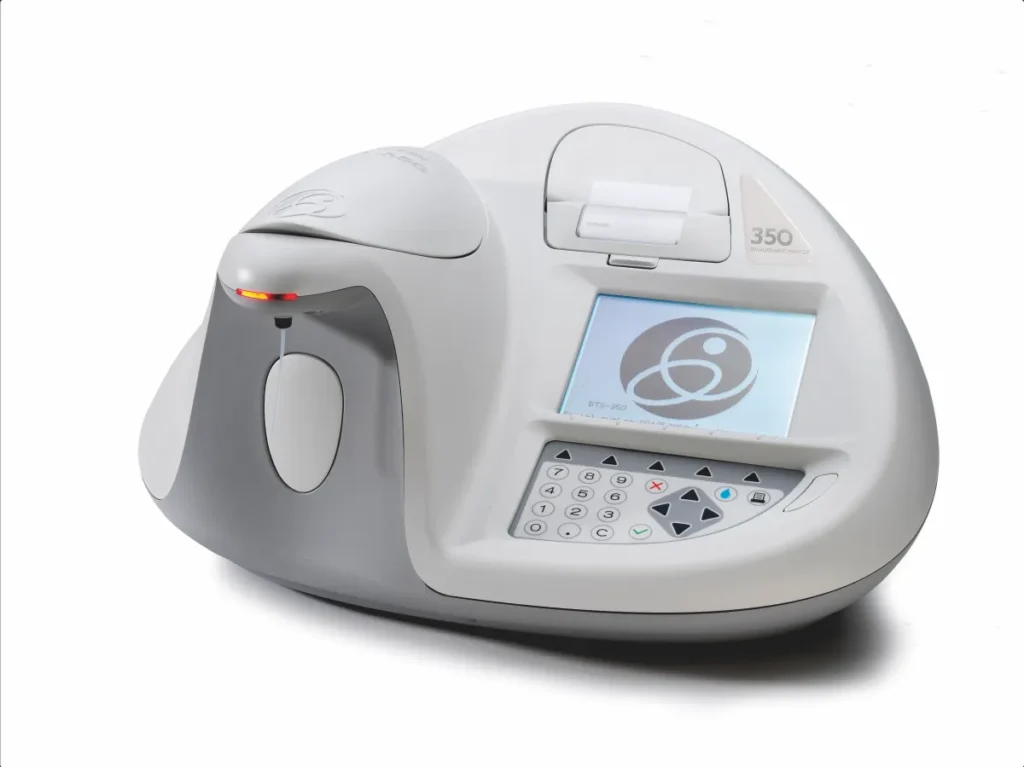
We were the first company capable of designing and producing semiautomatic and automatic analysers using full-range LED optical systems, being at the forefront of technology. We launched the BTS-350, our first semiautomatic analyser with full LED optical system, in 2009.
Some features of our Smart LED technology optical systems are:
They use a double beam design, with two silicon photodiodes, to achieve ultra-high stability, resolution and accuracy absorbance measurements, with a wide range.
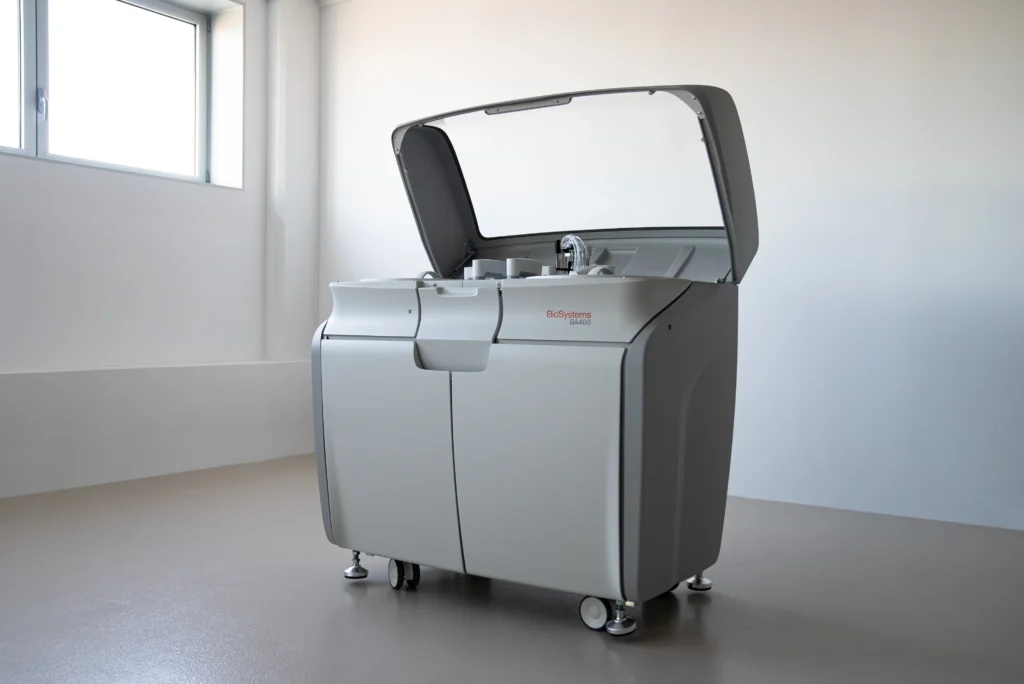
They have one dedicated LED for each wavelength. Therefore, they can individually control the light emission at each wavelength, achieving the suitable light intensity at all wavelengths to optimize the readings. In optical systems with halogen lamp, it is not possible to regulate the light intensity for each wavelength independently.
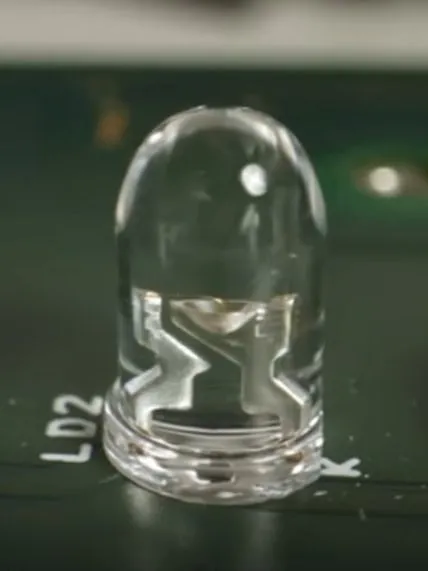
They don’t need any refrigeration system of its light source, and they don’t require any warmup time. Therefore, they don’t slow down the start-up of the analysers, and the temperature of the light source does not affect the reactions temperature. Optical systems with halogen lamps need refrigeration for the lamp and have to wait for the temperature stabilization of its filament to get a stable light source.
They have no moving parts and there are no mechanical adjustments, reducing drastically maintenance intervention. LEDs are switched at high speed, and the system can read, at the suitable light wavelength, 24 different biochemical reactions per second.
They have a practically unlimited lifetime, and there is no need for light source maintenance. Halogen Lamps must be replaced every 1,000-2,000 hours.
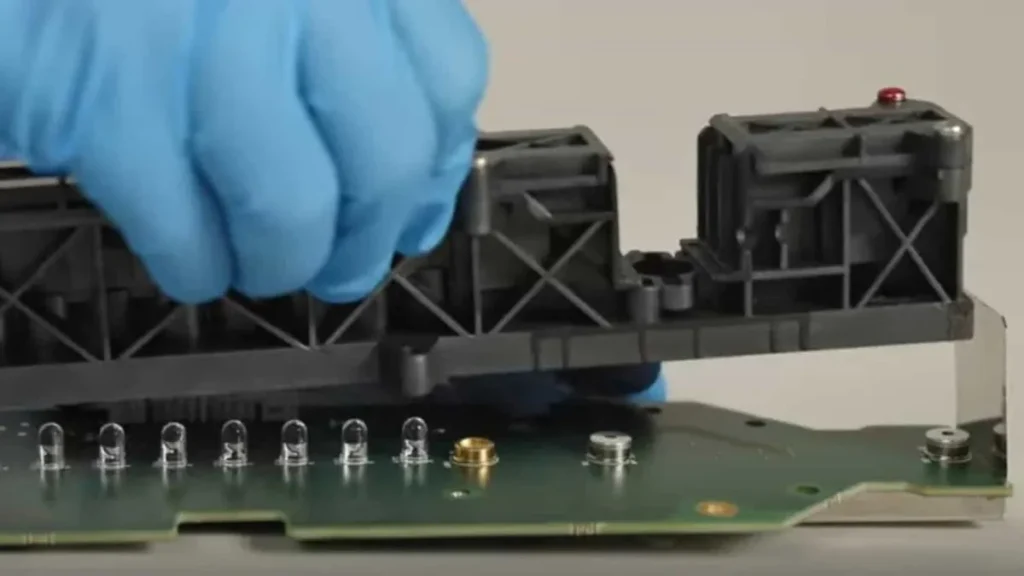
Since 2009, thousands of BioSystems instruments using these LED optical systems are reporting accurate and reliable results for our patients and users in hospitals and laboratories all over the world.